 info@mplogistics.vn
 (+84) 28 3811 9033


 Source: VinWonders
Ninh Binh is well-known for its natural landscapes. Today, it is also becoming a major economic and logistics hub in Northern Vietnam. The province is moving beyond a tourism image and adopting a strategic plan. This approach connects the Hanoi – Hai Phong region with the North Central Coast. As a result, Ninh Binh is turning into a natural meeting point for goods, services, and investment.
Local leaders now see logistics as a core industry. It supports many fast-growing sectors, including steel, automotive parts, electronics, and textiles. The province has added logistics to the Master Plan for 2021-2030, with a vision to 2050. This decision marks a shift toward a more systematic and long-term model. Instead of small, separate projects, Ninh Binh now focuses on smooth and efficient logistics flows.
Strong Multimodal Infrastructure

Ninh Co Economic Zone – a new driving force for Ninh Binh province’s development
1. Modern Road Network
The road system has improved quickly. Highways such as Cau Gie – Ninh Binh and Mai Son – National Highway 45 are expanding. In addition, Hanoi Ring Road 5 will shorten travel time and increase access to industrial zones. These new routes make transport faster and more reliable.
2. Rail and Waterway Advantages
The North – South railway crosses almost 100 km of the province. It offers a strong corridor for heavy cargo.
Meanwhile, the Day – Ninh Co canal has changed the market. This waterway allows continuous transport between the North and the South. It cuts freight costs and supports green logistics. Furthermore, many river ports along the Day and Red Rivers add more capacity.
3. Case Study: Thai Ha Port
Thai Ha Port shows the potential of this network. It is an intermodal hub between Hung Yen and Ninh Binh. The port can receive vessels up to 3,500 tons. After Phase II, it will reach 2 million tons per year. The site includes modern cargo equipment and storage facilities.
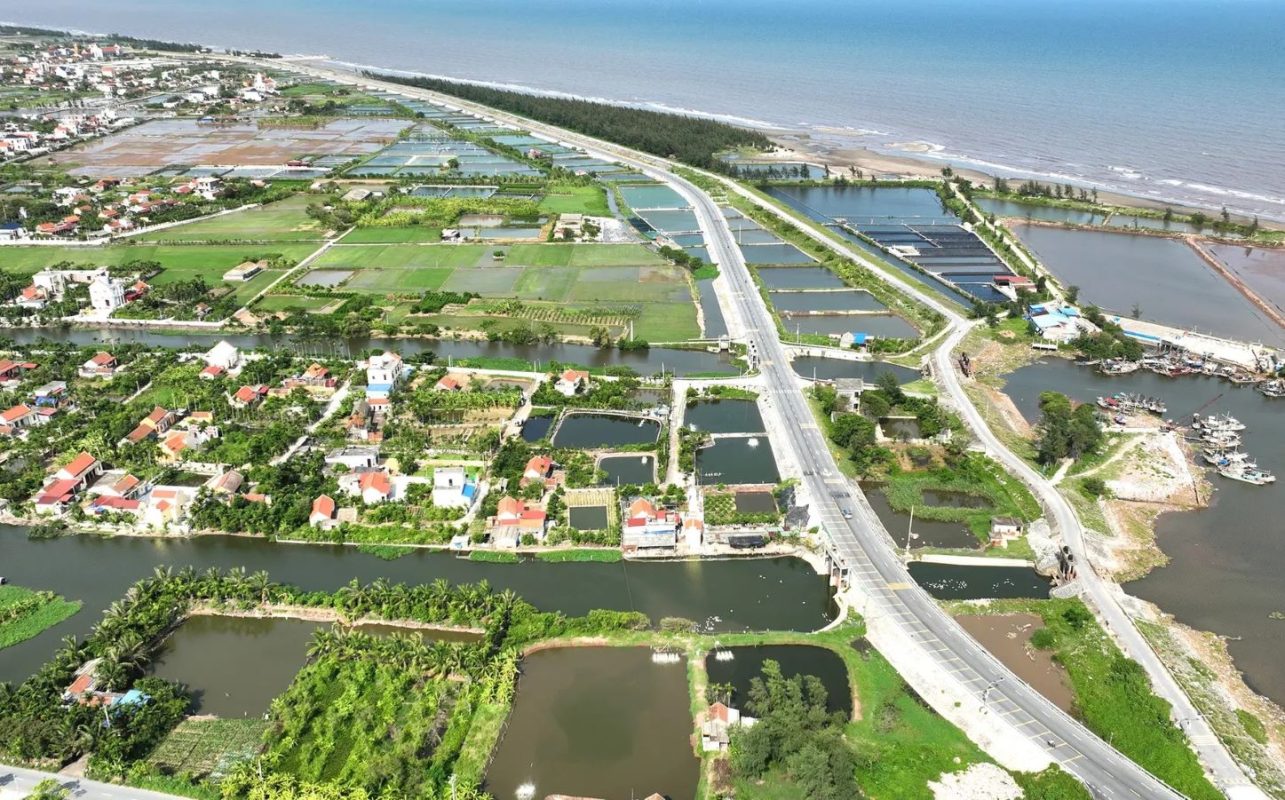
New Nam Dinh – Lac Quan Road – Coastal Road section passing through Hai Quang Commune. Photo: Viet Du
The demand side for logistics services in Ninh Binh is experiencing unprecedented growth, driven by aggressive industrial expansion and major anchor projects.
The province currently hosts 32 industrial parks, many of which have achieved near-absolute occupancy rates, indicating strong investor confidence. This is generating immense and complex logistics requirements, ranging from Just-In-Time delivery for the automotive sector to specialized bulk handling for steel and raw materials. The local business community, comprising approximately 1,100 enterprises involved in import and export activities across various high-value industries, provides a robust foundation for logistics development.
Further amplifying this demand is the government’s approval of the expansive Ninh Co Economic Zone. Covering nearly 14,000 hectares of coastal area, this zone is not merely an extension; it is envisioned as a future growth pole where industry, maritime tourism, energy, and logistics converge. Strategically located on the Gulf of Tonkin economic belt, the Ninh Co EZ is expected to attract global corporations, significantly increasing the volume of cargo requiring sophisticated logistics solutions. Major external projects, such as large-scale steel plants in neighboring provinces (e.g., Xuan Thien Nam Dinh and Xuan Thien Nghia Hung), are forming an integrated industrial chain that will further elevate logistics demand across the entire region.
Vision 2050: Ninh Binh – Logistics Hub of Northern Vietnam
Ninh Binh’s long-term strategy is defined by clear, quantifiable goals that place the province in the league of advanced regional logistics hub:
- 2030 Target: Logistics is planned to contribute between 7% and 9% of the provincial GRDP, with an ambitious annual growth rate of 10% to 15%. This requires increasing the ratio of enterprises outsourcing logistics services to 50-60% and ensuring 70% of the workforce receives formal training.
- 2050 Vision: The ultimate goal is for Ninh Binh to transform into a logistics hub, achieving international standards, with the sector contributing 10-12% of GRDP.
To achieve this, the province is planning a complete logistics network: one regional-level center, three provincial-level centers (at Hoa Lu, Tam Diep, and Kim Dong), a network of Inland Container Depots (ICDs), and direct service areas connected to industrial and economic zones.
Crucially, the province is planning the missing links for full multimodal integration:
- Deep-water Seaport: A major plan is underway to construct a deep-water seaport within the Ninh Co Economic Zone. This is the lynchpin required to fully integrate road, rail, and sea transport.
- Ninh Binh International Airport: With a proposed scale of 720 hectares and a capacity for 10 million passengers per year, the planned airport will complete the multimodal puzzle, ensuring air freight connectivity and establishing Ninh Binh as an all-encompassing transport hub.
Source: Vietnam Logistics Information Portal
14/12/2025






 VN
VN