 info@mplogistics.vn
 (+84) 28 3811 9033


Vietnam is projected to strengthen its position among the world’s major economies over the next four years. According to the International Monetary Fund’s World Economic Outlook April 2026, Vietnam’s nominal GDP could reach US$667.5 billion by 2030, placing the country 34th globally.
The projection also puts Vietnam close to Malaysia and ahead of Thailand in terms of nominal economic size. As Vietnam’s economy expands, growing trade flows, manufacturing activity and increasingly connected supply chains are expected to create additional demand for efficient logistics infrastructure and services.
Vietnam’s GDP Could Reach US$667.5 Billion by 2030
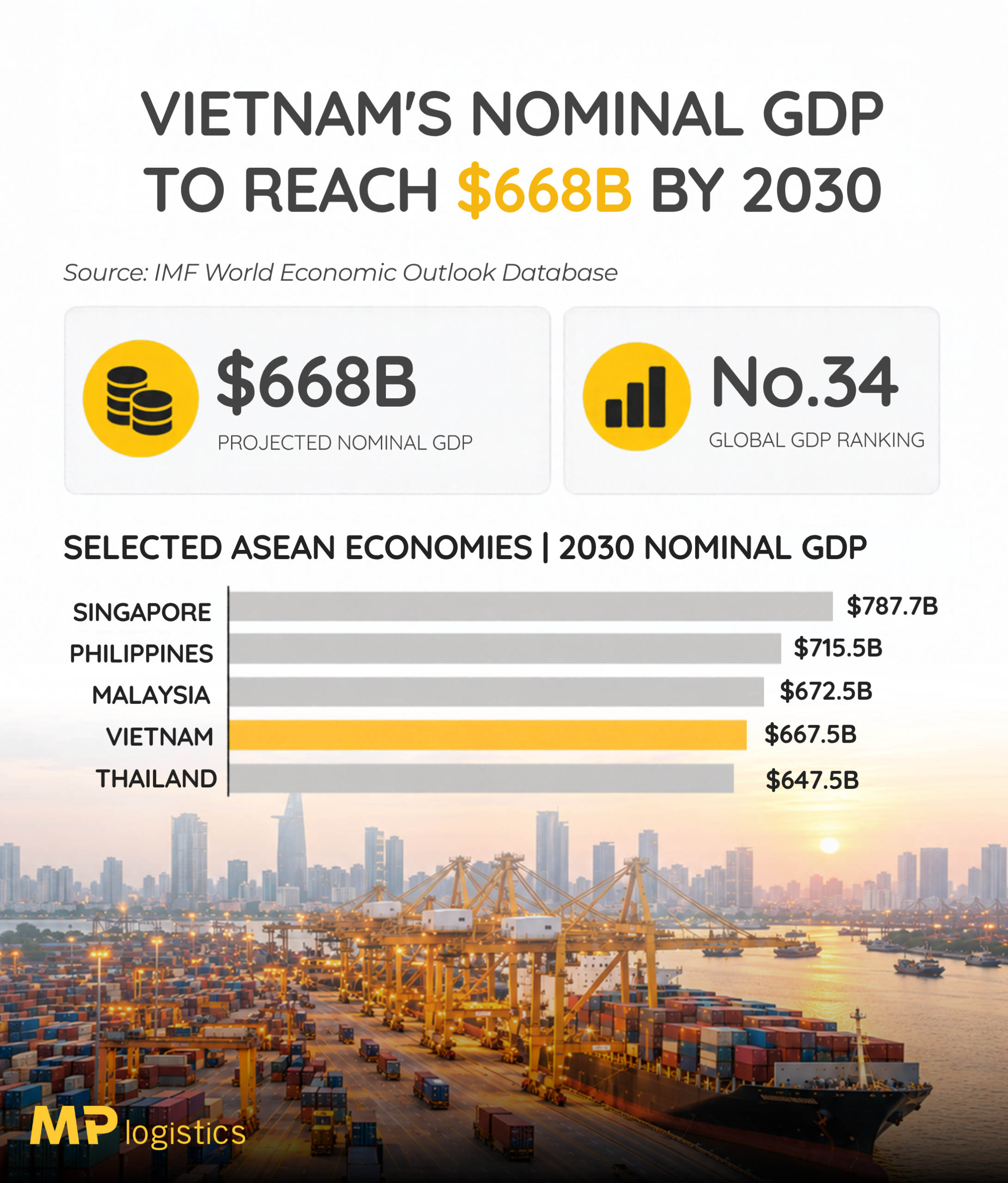
The IMF’s April 2026 outlook projects continued expansion in Vietnam’s nominal GDP over the coming years. From its current level, the economy is expected to increase steadily toward nearly US$668 billion by 2030.
At US$667.5 billion, Vietnam would rank 34th among economies worldwide based on nominal GDP. While nominal GDP is influenced by both economic output and price levels, it remains an important indicator of the overall monetary size of an economy.
The projection reflects Vietnam’s growing economic base and its increasing integration into international trade and investment networks. Manufacturing, exports, foreign direct investment and domestic economic activity are among the factors supporting the country’s longer-term growth outlook.
For businesses, a larger economic scale can translate into broader production networks, higher demand for goods and services and greater connections between domestic and international markets.
Vietnam Approaches Malaysia in ASEAN Economic Ranking
Vietnam’s projected economic size is particularly notable when compared with other ASEAN economies.
By 2030, Malaysia’s nominal GDP is projected at approximately US$672.5 billion, only around US$5 billion above Vietnam. Thailand is projected at US$647.5 billion, putting Vietnam ahead by roughly US$20 billion.
Singapore and the Philippines are expected to remain larger, with projected nominal GDP of approximately US$787.7 billion and US$715.5 billion, respectively.
This comparison places Vietnam within a closely contested group of major ASEAN economies.
| Economy | Projected Nominal GDP in 2030 |
|---|---|
| Singapore | US$787.7 billion |
| Philippines | US$715.5 billion |
| Malaysia | US$672.5 billion |
| Vietnam | US$667.5 billion |
| Thailand | US$647.5 billion |
The relatively small gap between Vietnam, Malaysia and Thailand highlights the changing economic landscape of Southeast Asia. Vietnam’s position is supported by its manufacturing base, export activity and role in regional supply chains.
Manufacturing and Trade Continue to Support Growth
Vietnam’s economic development has become increasingly connected with global production and trade.
The country has attracted substantial foreign investment into manufacturing, particularly in sectors such as electronics, machinery, textiles, footwear and other export-oriented industries. Multinational companies have also expanded production networks in Vietnam as part of broader supply chain strategies across Asia.
This manufacturing activity generates demand across the entire logistics chain. Raw materials and components need to be imported, processed and transported to production facilities, while finished products must then move through domestic distribution networks and international gateways.
As Vietnam’s economy grows, the scale and complexity of these flows are also expected to increase.
International trade therefore remains closely linked to the country’s economic outlook. Export growth can support manufacturing activity, while imports provide businesses with the machinery, components and materials required for production.
Vietnam’s Growing Role in Regional Supply Chains
Vietnam has become an important manufacturing and sourcing location within Asia. Its extensive network of free trade agreements, proximity to major Asian markets and expanding industrial base have supported its integration into regional and global supply chains.
The country’s participation in agreements such as CPTPP, EVFTA and RCEP provides businesses with access to a broad network of international markets.
At the same time, the development of industrial parks, seaports, highways and logistics infrastructure is helping connect production centers with domestic and international markets.
As investment continues to expand, logistics networks will need to support increasingly diverse cargo flows. This includes not only traditional export commodities but also higher-value manufactured goods, components and time-sensitive shipments.
A more connected logistics system can help reduce unnecessary delays, improve cargo visibility and support more predictable delivery schedules.
Vietnam’s Economic Scale Continues to Rise

The IMF’s April 2026 projection of US$667.5 billion in nominal GDP by 2030 places Vietnam at an estimated 34th globally, while bringing the country’s economic scale close to Malaysia and above Thailand.
The forecast reflects Vietnam’s expanding role in manufacturing, trade and regional supply chains. As the economy grows, the movement of goods between production centers and international markets will become increasingly important.
For Vietnam to translate its expanding economic scale into stronger trade competitiveness, efficient infrastructure and well-connected logistics networks will remain essential.
By 2030, a larger economy is likely to mean not only more goods moving through Vietnam, but also more complex supply chains connecting Vietnamese businesses with customers and partners around the world.





 VN
VN