 info@mplogistics.vn
 (+84) 28 3811 9033


Vietnam has maintained a stable energy supply amid unprecedented global disruptions, placing it among just 13 out of 177 countries surveyed that managed to sustain energy stability in 2026. Despite rising electricity demand, extreme weather conditions, and disruptions to international energy supply chains, the country has successfully ensured uninterrupted power supply without resorting to scheduled power cuts.
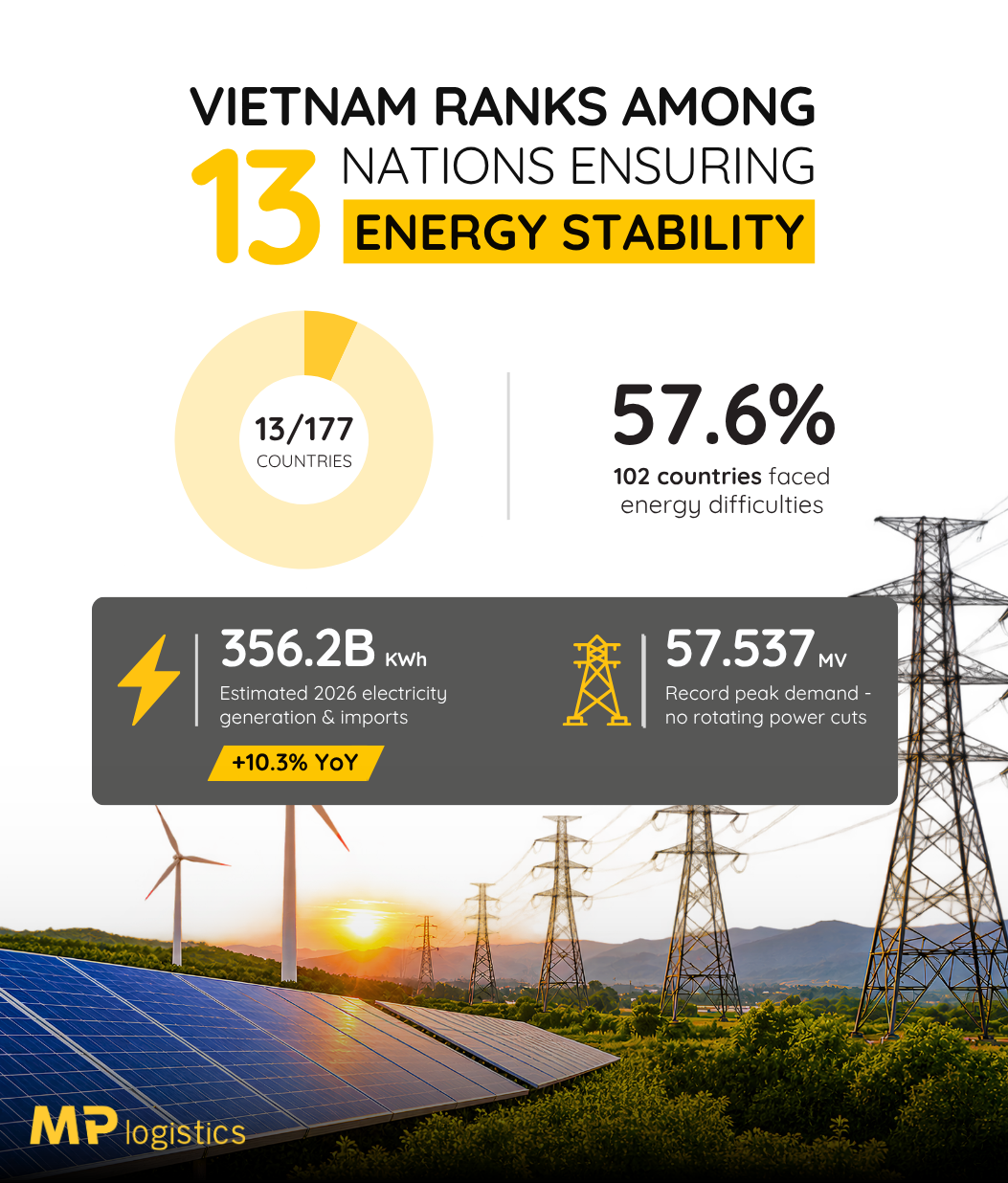
According to the Vietnam Energy Security Report 2026, total electricity generation and imports are estimated at 356.2 billion kWh, up 10.3% year-on-year. Meanwhile, peak electricity demand reached a record 57,537 MW, highlighting the country’s growing energy requirements and its efforts to strengthen supply reliability.
This achievement underscores the importance of energy security as a foundation for economic growth, industrial development, and resilient supply chains.
1. Vietnam Among 13 Countries Maintaining Energy Stability
According to the Vietnam Energy Security Report 2026, released by the Ministry of Industry and Trade on November 10, only 13 out of 177 surveyed countries maintained stable energy conditions as of November 9, 2026. Meanwhile, 102 countries, equivalent to 57.6% of those surveyed, faced energy-related difficulties.
Vietnam’s inclusion in this group reflects its ability to maintain energy supply despite significant global challenges, including disruptions to strategic shipping routes, rising fuel prices, extreme heatwaves, and increasing electricity demand.
The Strait of Hormuz blockade disrupted international energy transportation for approximately six months, while Brent crude oil prices reached as high as US$118.35 per barrel. At the same time, record temperatures and the El Niño phenomenon placed additional pressure on electricity systems worldwide.
Against this backdrop, Vietnam’s ability to maintain stable electricity and fuel supplies represents a significant achievement in national energy security.
2. Electricity Generation and Imports Reach 356.2 Billion kWh
Vietnam’s electricity demand continued to rise alongside economic activity and industrial expansion.
In 2026, total electricity generation and imports are estimated at 356.2 billion kWh, representing a 10.3% increase compared with 2025. This figure is approximately 6.2 billion kWh higher than the baseline forecast.
Key electricity indicators include:
- 356.2 billion kWh: Estimated electricity generation and imports in 2026.
- 10.3%: Year-on-year growth in electricity supply.
- 57,537 MW: Record national peak electricity demand on June 24, 2026.
- 30,248 MW: Peak electricity demand in Northern Vietnam.
- 9.84%: Growth in commercial electricity consumption during the first 10 months of 2026.
Despite record electricity demand and three extreme heatwaves, Vietnam avoided scheduled power cuts nationwide.
The ability to maintain an adequate electricity supply demonstrates the importance of coordinated power system management, infrastructure investment, and proactive demand planning.
3. Strengthening Energy Infrastructure to Support Rising Demand
Maintaining energy stability requires more than sufficient electricity generation. A reliable transmission and distribution network is equally essential to ensure that electricity reaches industrial zones, manufacturing facilities, and residential areas.
During the first nine months of 2026, the power sector commenced construction on 136 grid projects and put 131 projects into operation.
These developments contribute to improving transmission capacity, strengthening regional connectivity, and reducing pressure on the national power system.
At the same time, electricity consumption is increasing alongside industrial production, urbanization, and investment expansion. Commercial electricity consumption rose 9.84% in the first 10 months of 2026, approaching the country’s GDP growth rate.
As demand continues to grow, accelerating power infrastructure projects and improving grid efficiency will remain essential to maintaining long-term energy reliability.
4. Securing Fuel Supply Amid Global Energy Disruptions
Beyond electricity, Vietnam also maintained domestic petroleum supply despite disruptions to major international shipping routes.
The country’s two major refineries, Dung Quat and Nghi Son, produced approximately 12.1 million tonnes of petroleum products during the first nine months of 2026.
Their operating performance reached approximately:
- Dung Quat Refinery: 123% of adjusted designed capacity.
- Nghi Son Refinery: 112% of adjusted designed capacity.
Vietnam also diversified its crude oil supply sources from one type to more than ten, helping reduce dependence on individual supply channels.
These measures helped maintain domestic fuel availability without requiring the use of national petroleum reserves.
The developments highlight the importance of supply diversification, domestic refining capacity, and strategic coordination in strengthening national energy resilience.
5. Energy Security: A Foundation for Manufacturing and Logistics Growth
Stable energy supply is a critical requirement for maintaining industrial productivity and the efficient movement of goods.
Manufacturing facilities depend on reliable electricity to maintain production schedules, operate machinery, and meet delivery commitments. Similarly, logistics operations rely on stable energy supplies to support transportation, warehousing, cold-chain systems, cargo handling, and distribution networks.
For export-oriented industries, even temporary energy disruptions can lead to production delays, higher operating costs, and interruptions across interconnected supply chains.
Vietnam’s ability to maintain stable energy supply therefore provides an important foundation for business continuity and industrial competitiveness.
As the economy expands, businesses will increasingly need to consider energy efficiency, operational resilience, and sustainable resource management as part of their long-term strategies.






 VN